
Why would an artist take on a public commission? Issues around planning, costs and conservation are baked into the job, legal situations often arise and the court of general opinion tends to judge harshly. As curator and cultural writer Francesca Gavin puts it: “You can’t deny it — 95 per cent of public art is bad.”
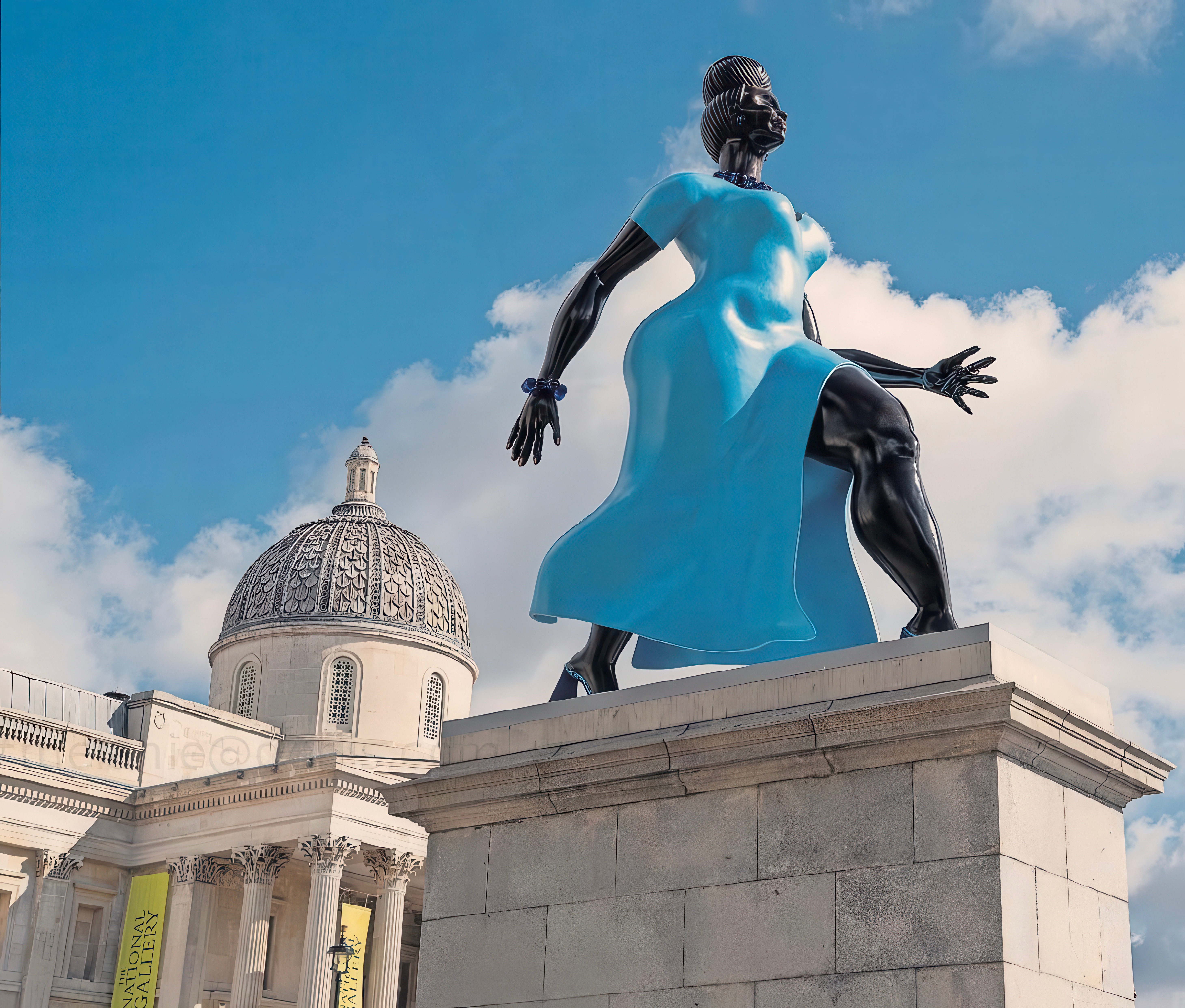
Works currently sparking debate include Tschabalala Self’s “Lady in Blue”, installed on London’s Trafalgar Square fourth plinth this month, which is either “joyful” or “decidedly misjudged”, depending on what you read. At the more extreme end of the scale, Maggi Hambling’s 2020 silvery tribute to the feminist Mary Wollstonecraft met with almost universal outrage.
The stakes are high, according to Jo Baring, a curator and author of Totem: The Untold Story of Sculpture, published this month. “We ask more of our public sculpture than of paintings in museums, especially in our community, where it has to meet us on our own territory,” she says.
This is part of the thinking behind the recent launch of IGP Arts, the cultural arm of UCL’s Institute for Global Prosperity, to “place creative practice more firmly at the heart of what it is to lead a good life,” says Professor Henrietta Moore, founder and director of the IGP.
“I don’t think all public art is bad,” she says, seeing it as a vital counterpoint to the daily deluge of images in our visual society. These include “advertising for things that are really bad for you or awful political sloganeering, particularly in the poorest parts of the UK,” she says, citing research with MTArt Agency.
Works that don’t connect to the people who walk past them often fail at the outset, experts say. Moore and others call out property developers as behind the so-called “turd in the plaza” phenomenon. The phrase, coined by American artist and architect James Wines, has been used to describe apparently abstract sculptures that seem to pop up everywhere, and applied to works by artists from Henry Moore to Anish Kapoor.
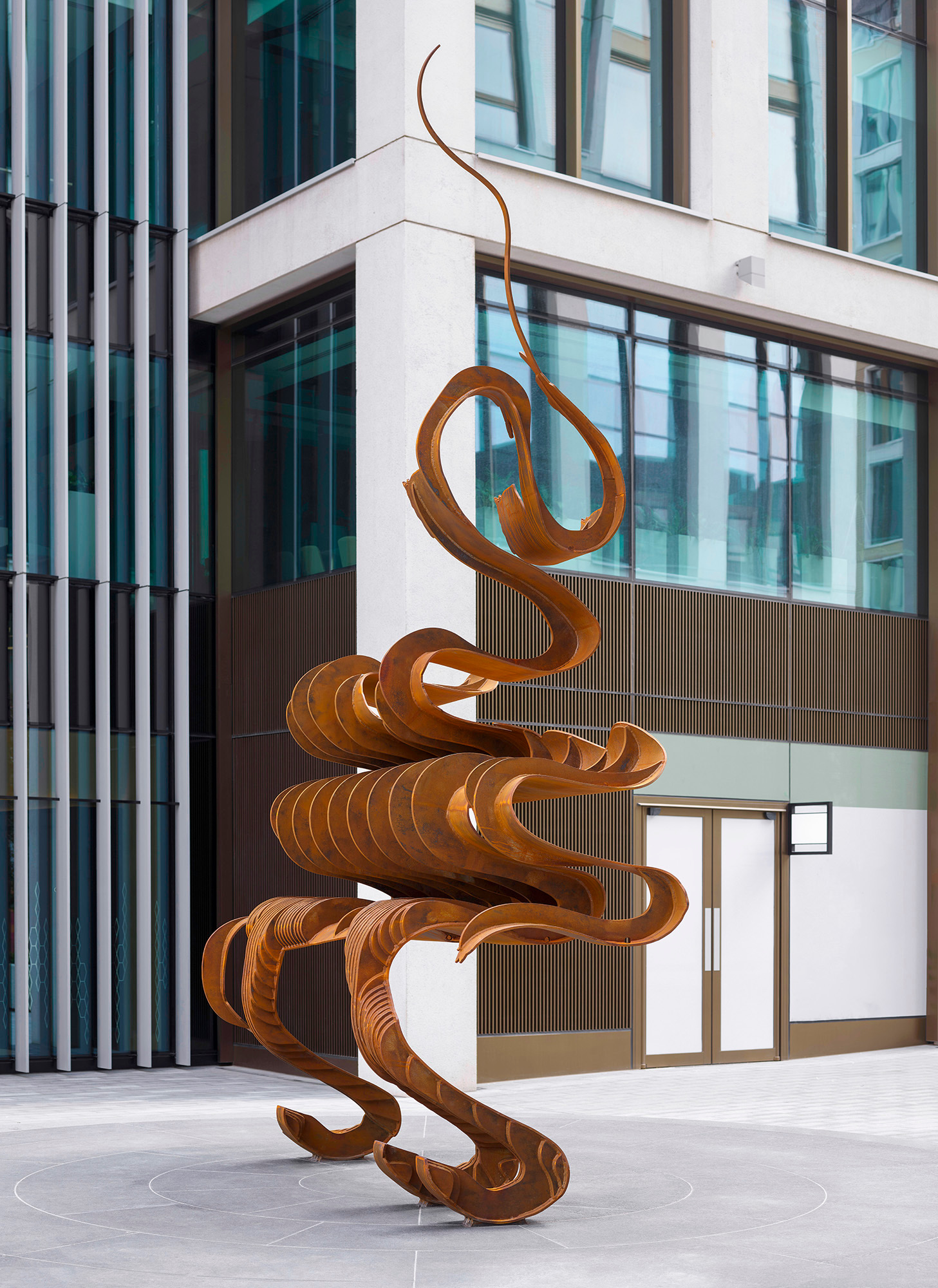
For the sculptor Nick Hornby, pointing the finger at developers is “the classic cliché that all private money is bad.” One of his best experiences, he says, was working with Northacre for his Westminster sculpture “Power over others is Weakness disguised as Strength” (2023), either wavy lines or Richard the Lionheart on horseback, depending on where you stand. In 2024, this won the public vote for the Marsh Award for Excellence in Public Sculpture
Henrietta Moore finds that art that evokes, then challenges, traditions in this way plays well with the public. She highlights London’s first statue of a postpartum mother, complete with the linea nigra abdominal mark, by Rayvenn Shaleigha D’Clark, initially sited outside a maternity ward. As well as its everyday life approach, Moore describes “Mother Vérité” as “the body of someone who has just given life to another body, while the vast majority of the public spaces in London have statues of men on horseback, celebrating just having killed people.” The relative popularity of Banksy’s blinded flag-carrier on Waterloo Place plays to the same theme.
Community engagement was crucial to the making of “Mother Vérité”, Moore says — the artist interviewed and scanned 40 post-partum women — though others find that extensive discussions are the start of the problem when it comes to public art (neatly avoided by Banksy’s guerrilla tactics). “Curating anything by committee is a fool’s errand. We all know that art cannot and should not please everybody at the same time,” says Jon Sharples, a specialist art and intellectual property lawyer at Howard Kennedy.
Locals are by no means the only interested parties. “The client, developer, art consultant, architect, landscape architect, project manager engineer and site manager all weigh in,” Hornby says. “There needs to be clarity about where that expertise ends and artistic authorship begins.”
Blurred ownership of works in the public realm can lead to unwanted outcomes. In 2014, Antony Gormley’s now generally admired “Angel of the North” (1998) was hijacked by the UK supermarket chain Morrisons for a price-cutting campaign. For this, they projected an image of a baguette across the entire 54-metre wingspan of the sculpture with the slogan “I’m cheaper”. Gormley voiced his displeasure and received a public apology from the supermarket, though not before the imagery had been circulated round the country.
Other artists have taken legal action to protect the integrity of their works. In 1979, a commission from the developers of the Eaton Centre shopping mall in Toronto, Canada resulted in a flock of 60 realistic-looking flying geese by the artist Michael Snow (“Flight Stop”). During the 1982 Christmas shopping season, staff placed festive red ribbons around the birds, leading to a landmark action that found the Centre’s operator liable for violating Snow’s moral rights — and off came the ribbons.
Some thought might also be given to the juxtaposition of various artworks — a legal zone of exclusion — which could alter perceptions, for better or for worse. Tracey Emin’s neon “I Want My Time With You” (2018) in the St Pancras Eurostar terminus seems a relative masterpiece when viewed alongside the looming kitsch of the less-loved “The Meeting Place” kissing couple designed by Paul Day (2007).
Such considerations add to the “largely invisible cost” to an artist of lengthy project timelines, Hornby says. More prosaic problems, such as the weather and bird droppings, mean that public sculpture is an ongoing responsibility — but whose? “The artwork may remain for 50 years while the commissioning team may exist for two,” he says. “Sites are sold, management companies change, consultants move jobs and contracts are not always handed over. Within a surprisingly short period, there can be nobody left who knows the history of the work or who is responsible for it.”
Time plays a role in the eventual appreciation of public art, Baring finds. “[It] succeeds when it connects to the emotional heart of sculpture — to give physical form to collective values. That needs time to grow. The most enduring works don’t reflect current taste but are vessels for memories,” she says. She cites Gormley’s “Angel of the North”, which initially met with criticism, including comparisons to the style of Third Reich architect Albert Speer. Now, Baring says, part of its appeal is that “for many, when you drive past it, it reminds you of visiting your parents.”
“It’s a real leap of faith to work in public space,” Sharples says, though Baring welcomes the debates. “The earliest known sculpture, ‘Lion Man’, was carved 40,000 years ago from a mammoth’s tooth. It heartens me that we are still arguing about such art forms today,” she says.